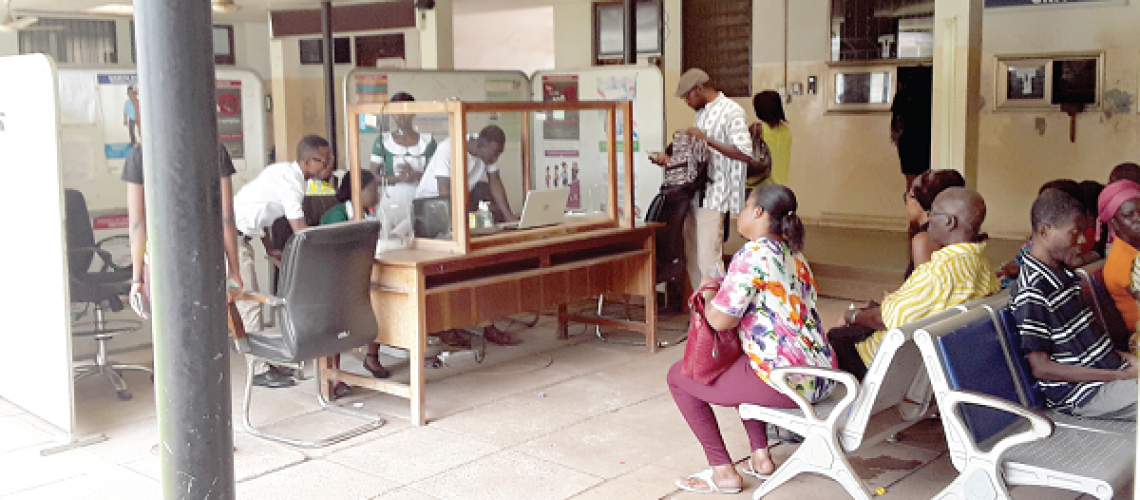

Once a person gains admission to study at the University of Ghana, the major concern amidst the excitement is accommodation. For especially those who come outside of Accra to enroll in the university, their worry is mainly where to lay their heads. But there is also an essential amenity that not everyone pays attention to; the provision of healthcare on campus. For many of us, ill-health mostly comes to us once in a while. Sometimes not at all through our studies. But whenever it comes, it brings to bear, the enormous importance of the availability of quality accessible healthcare.
Backdrop
I woke up yesterday with a bloodshot eye. And today I met with my buddy, Shaban, who upon seeing my eyes became worried and suggested I see a doctor at the University Hospital. In fact, prior to that, I did not think that the hospital had the capacity to examine an eye. Not only because I had not been there before, but I assumed the facility to not be any more than the sickbays we have in Senior High Schools. Or at best, a clinic. Note: The University of Ghana Medical Centre is distinct from the Legon University Hospital.
I was pretty surprised when I saw the structure of the hospital. Because it matches up to its name: hospital. It is just like the district hospitals we have across the country. But that was not it. I also had a good medical care experience at the facility.
In this blog post, I am going to tell you why in the area of health, the University of Ghana has got it. And why the university’s health facility is the immediate go-to place for your medical care if you ever fall ill, while on campus.
All services at the hospital are free for UG students
When you prepare to go to campus in a particular semester, you probably budget for your feeding, your socials, your wardrobe, your whatever, and for contingencies that may arise. At the University of Ghana, you don’t necessarily have to make provision for healthcare, precisely primary healthcare. This is because the school, as explained to me, has got you covered with some insurance policy of a sort. And you pay your premium as part of your fees on yearly basis, through your study.
In my experience today, I walked into the record-keeping area, where I was logged into the system. Then I was given a chit showing my biodata. While nonstudents paid for all services rendered, I did not have to worry my head over that. You do not need any insurance card to access healthcare as a student, your student ID serves just that.
Now Shaban, who has been at UG since 2014, now doing his master’s; enlightened me to the effect that, if a student goes to the University Hospital and is referred by same to a different hospital, the school still bears the cost of the peripheral healthcare, under the insurance policy. And if a student foots such bills, he can send the receipt to the school’s accounts department for a refund. Of cause, students will also have to prove that they were referred to the said hospital by the University Hospital.
He admitted that the bureaucracy discourages people from going to get a refund. Shaban also said throughout his stay on campus he has benefitted from the insurance without holding any insurance card of any sort.
You do know this is a cool deal, don’t you?
The health workers are your friends
Have you ever been to a health facility where some rude personnel snarled at you and made you rage away your sickness? Or has a nurse ever ignored your ailing self to concentrate on their phone or television? It gets really frustrating when a health worker gives cold shoulders at the hospital. No doubt, in the ethics of healthcare delivery, reception matters. Sometimes the way you get treated alone suffices as a panacea to your sickness.
When I visited the University Hospital, I felt at home. From the record-keeping desk to the cashier’s desk, to the initial consulting room where my vitals were taken, to the main consulting room, and to finally the room I was asked to go and get something for the doctor I was consulting with; all I got was warmth and respect. And oh, not to forget the injection room where I went to book my next appointment.
I have been to a number of hospitals and clinics in my life, but I have never experienced the welcome I was greeted with at the University Hospital. In my experience, I could ask any question at any length, and in all the rooms that I had been, no one showed a sign of being stretched or fed up with my interrogations. My consultation session was more like a casual talk over black coffee. In describing the staff of the hospital, hospitable is an understatement. Professionalism is still an understatement.
Proximity to campus
Before the University of Ghana Medical Centre is completely opened to the public, the University Hospital is the closest state of the art health facility to campus. What it means is that, you can immediately dash in there for your care and if you need to be transferred elsewhere, the ambulance will be handy to facilitate that. Remember, at no cost.
You can even walk to the facility if you do not have money to board a car and you will receive your health care under insurance coverage.
The University Hospital is located behind the Legon Police Station, across the road from the main entrance.
It is a place to make new friends
You may be wondering how a hospital will be a place you make friends. Actually, it is. Because at the University Hospital, you get to meet other students, if you’re lucky, your coursemates that you never knew. Because it is effectively a student environment, it’s easy to meet like-minded people at that place. Some, you might even be working on your next extracurricular projects with. We meet valuable people in the strangest of ways. You never know.
When I was at the hospital, I got the chance to while away time with fellow students. Something you can’t do elsewhere because there will be no binding factor between you and other patients. Factors such as coming from the same school. So you do know it is hard to break the ice in such situations.